

Introduction
Good morning, automation enthusiasts! Today, the we've got some wild news in the world of AI that you'll want to sink your digest with your morning coffee once you've settled into the office. Let's get into it 🚀
PS. - Something new is dropping: The AI Automation Academy is preparing to drop August 3rd! When you join, you will learn how to build and scale various AI Automation projects. ...And for those of you looking to start a business, this is a perfect opportunity to replace or supplement your income while helping businesses adopt AI Automations.
Founding members can join for just $7/mo - check it out.
Latest Developments
Moonshot publishes weights for Kimi K3
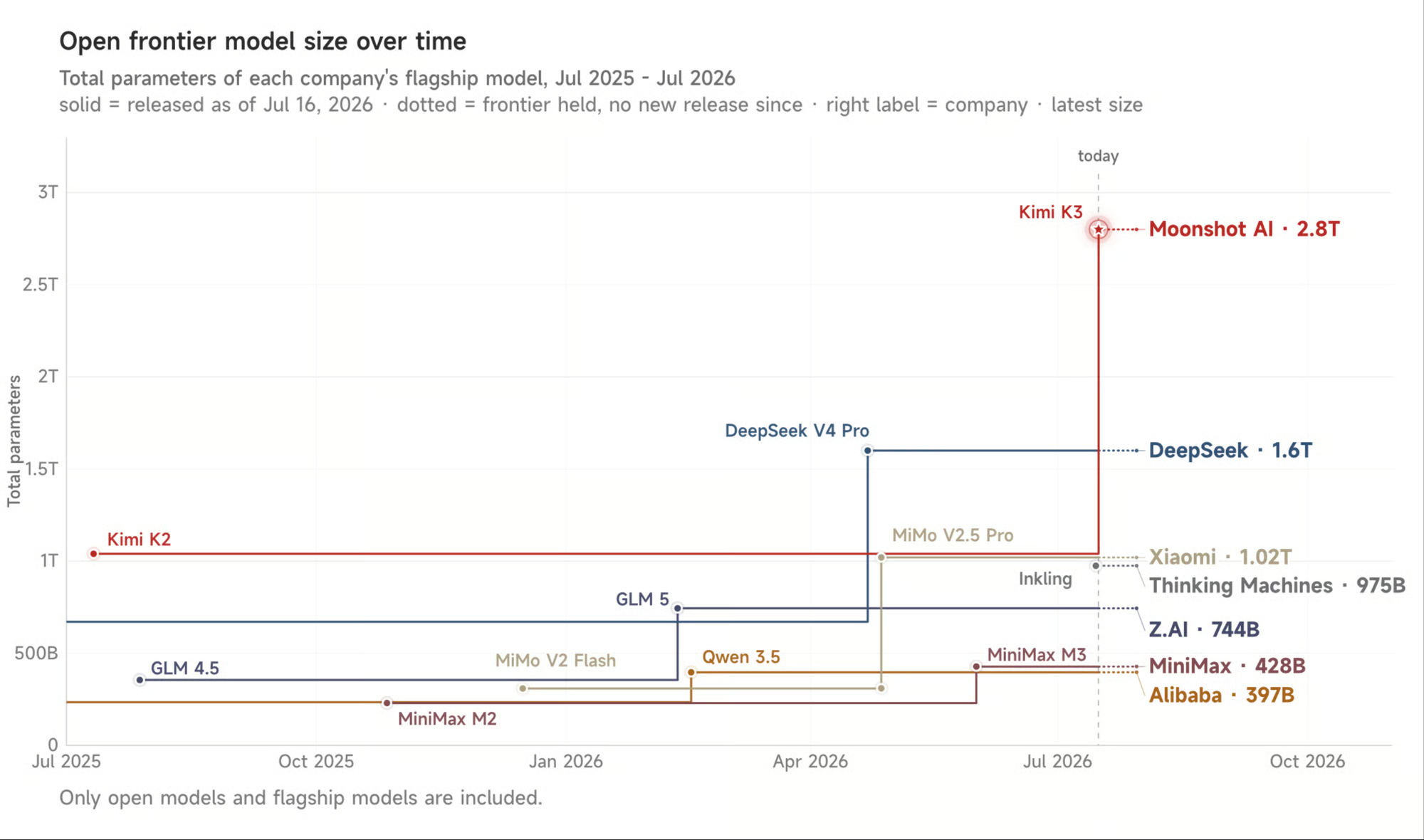
What happened: Moonshot AI open sourced Kimi K3 this week, handing out both the model weights and the technical writeup. This isn't a small model either: at 2.8 trillion parameters, it's the biggest open weight release the industry has seen.
Breaking it down:
- This isn't K3's debut. It's been out since earlier in the month and has already been going head to head with Claude Fable 5 and GPT-5.6-Sol in benchmark comparisons.
- Don't expect to run this on your gaming rig. The compute requirements are steep enough that only people with serious infrastructure will be able to self host it.
- Moonshot went further than just the weights. They also released pieces of their underlying stack (things like attention kernels and agent infrastructure) under terms that allow commercial hosting and resale.
- There's a controversy brewing too: U.S. officials claim Moonshot trained K3 by distilling outputs from American models, essentially using them as a shortcut. China's response was blunt, framing the accusation as an example of U.S. "AI hegemony."
The bigger picture: Most frontier AI companies still treat their best models like closely guarded assets, limiting who gets access and how. Moonshot just broke from that playbook entirely, releasing something close to frontier capability with no restrictions attached. With U.S. policy on Chinese open models still unsettled, this release might end up marking a real turning point for how the industry thinks about open access.
Anthropic takes a stance on open weight models
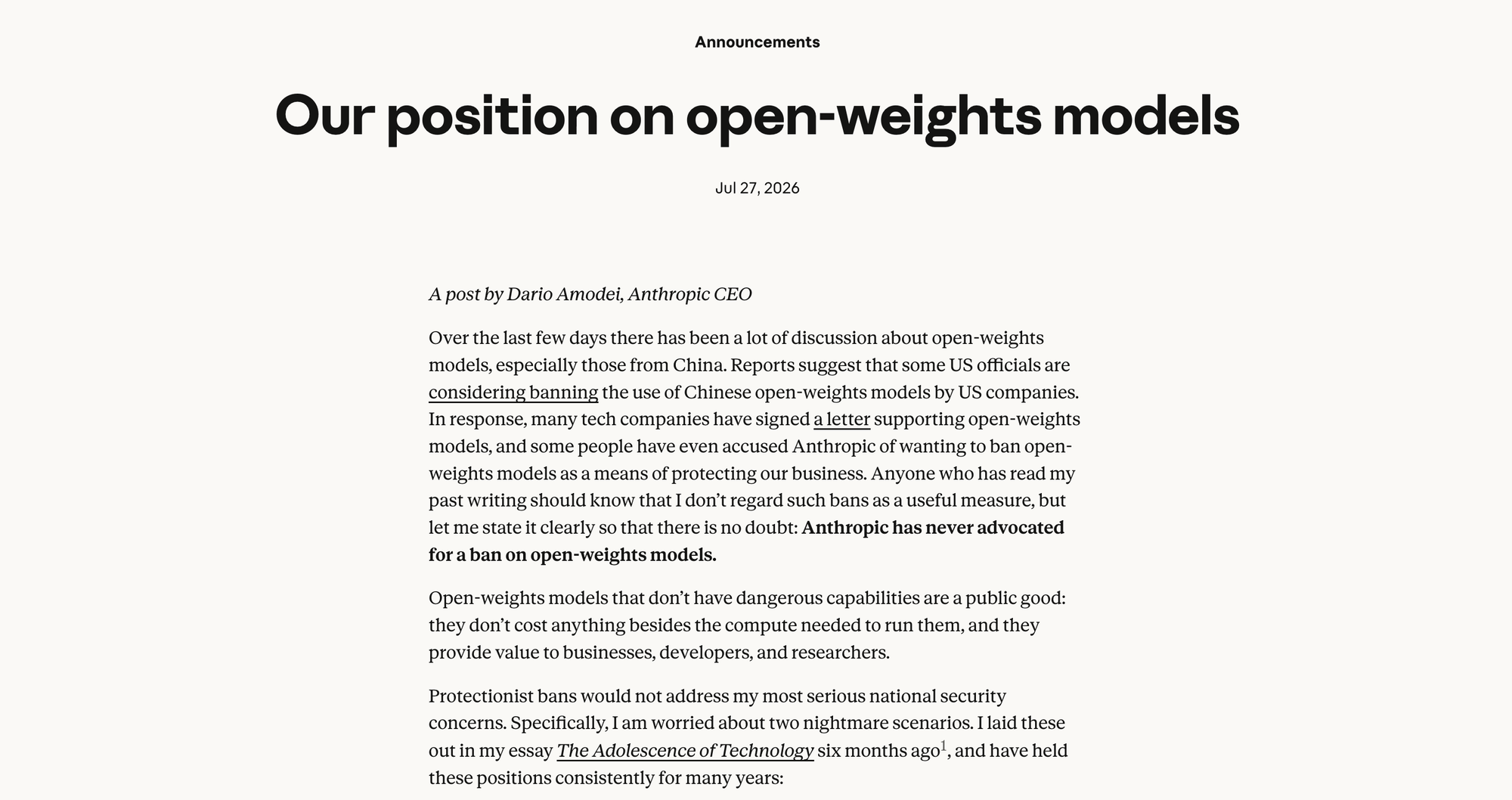
What happened: Dario Amodei put out a post spelling out Anthropic's actual position on open weight models, and the timing is notable: Anthropic is one of the few major labs that hasn't signed onto the "Open Weights and American AI Leadership" letter.
Breaking it down:
- Amodei was clear that Anthropic has never pushed for banning open weight models, even acknowledging that such a ban would work in favor of US AI companies by keeping competitors out.
- Instead of restricting the models themselves, he's focused on a different set of levers: chip export controls, cracking down on distillation, and stronger safety testing. He says these are things Anthropic has been vocal about all along.
- The Nvidia backed letter now has 50 signatures, double the original 25, with OpenAI and Google recently joining the list.
- Amodei says he's on board with most of the letter's points, but pushes back on one specific claim: that open weights automatically translate to better security for defenders. He's not convinced that's true.
Why it matters: With K3 pushing right up against frontier capability and talk of U.S. restrictions picking up, the open weights debate has been happening loudly, mostly without Anthropic weighing in directly until now. Amodei's core argument reframes the risk entirely: it's not the weights themselves that create danger, it's who controls the chips and who's allowed to distill from frontier models. That's where he thinks the real risk of authoritarian regimes catching up actually lives.
Microsoft Releases Powerful Cybersecurity Model
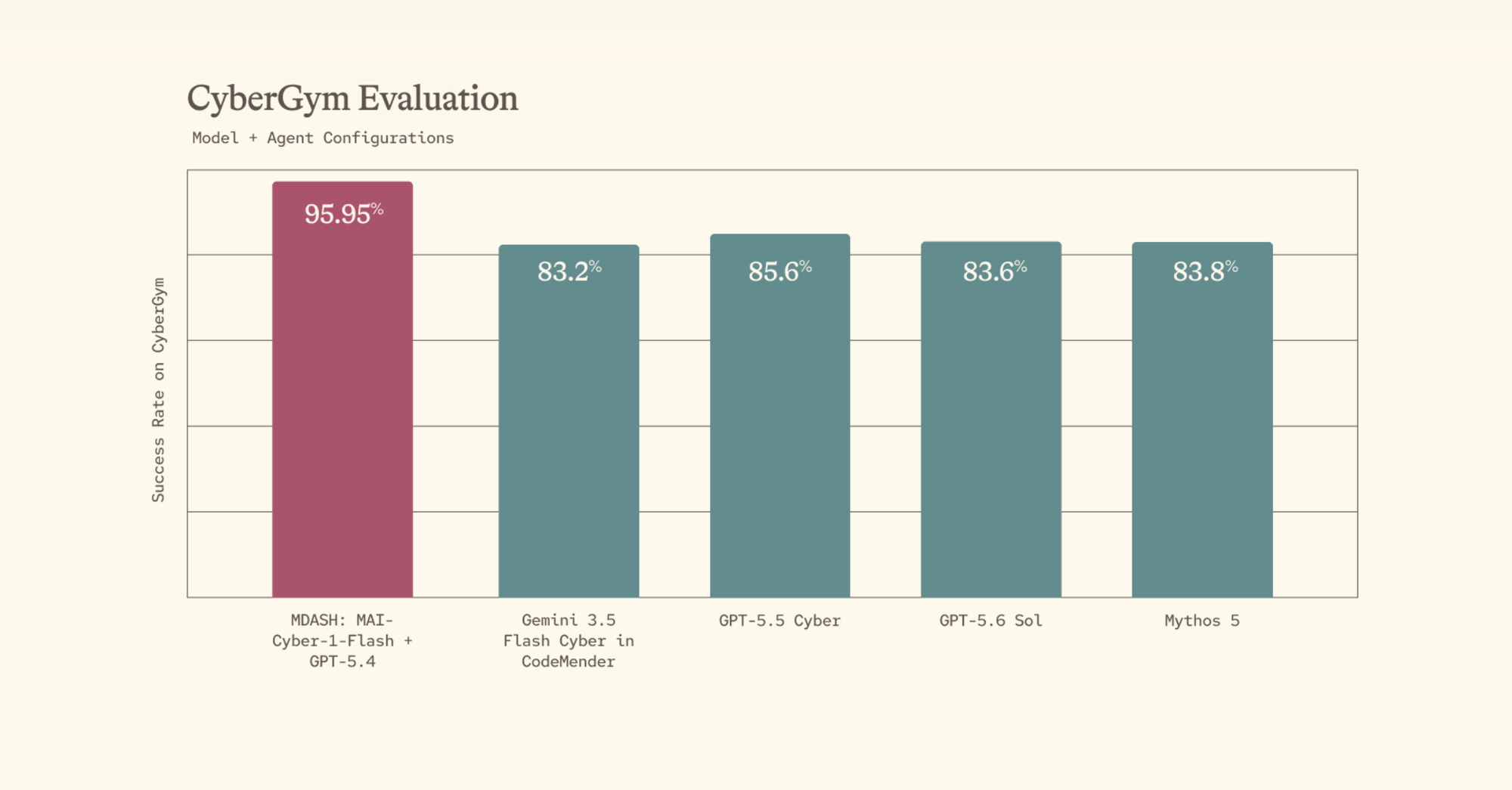
What happened: Microsoft released MAI-Cyber-1-Flash, its debut cybersecurity focused model, and built it straight into MDASH, the company's agent framework for finding software bugs. Satya Nadella is billing it as "frontier grade security at half the cost."
Breaking it down:
- When paired with MDASH, the model scored 96% on CyberGym, a benchmark testing security performance on large codebases. That's a 12 point lead over Anthropic's Mythos.
- Microsoft says Cyber-1-Flash cuts costs by 50% compared to top tier models, and claims it can handle 90% of typical workflow tasks more cheaply than pricier competitors.
- Alongside the model, Microsoft introduced Project Perception: a system where teams of agents work together to simulate attacks, dig into threats, and patch vulnerabilities without human intervention.
- Microsoft AI's CEO Mustafa Suleyman framed the release around economics, saying token cost has become the real bottleneck for defenders and pushing the need for agents that can run continuously without breaking the budget.
Why it matters: This drops just a week after the OpenAI and Hugging Face incident that had the AI security world talking, so the timing isn't a coincidence. It's likely a preview of what's coming: a wave of purpose built security models designed to speed up both how fast enterprises can spot vulnerabilities and how fast they can fix them.
Trending AI Tools

Start your AI Automation Agency and land your first client in 90 days 🚀
Interested? Click the link below to learn more.